Plan the Key Steps of the Test Strategy
Define Your Milestones
Planning is a bit like creating a meal plan for the coming weeks, where each "recipe" represents a project step you need to prepare.
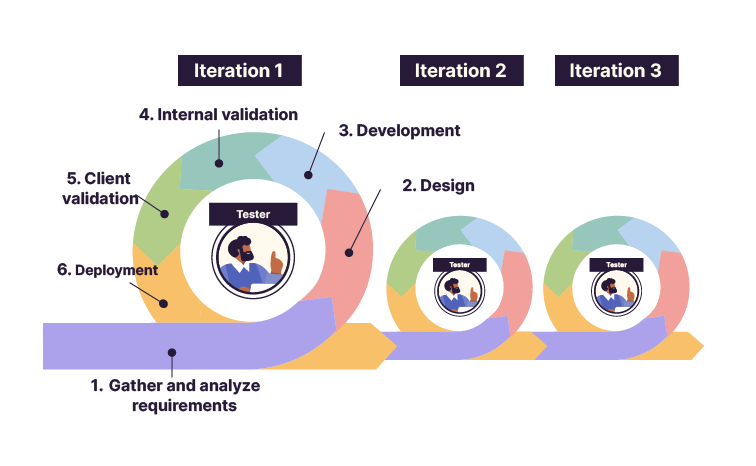
As a reminder, here are the iterative stages of Agile methodology and where testing fits in:
Sprint planning.
Feature design.
Development.
Testing.
Deployment.
Review.
Launch, then plan the next sprint.
Don’t worry—planning is much simpler than it looks.
For your testing phases, here’s what you’ll need to plan for each sprint:
Requirements analysis.
Test strategy.
Test plan design.
Test plan execution (including defect tracking).
Report and campaign summary.
Except in special cases, these five elements must be planned.
Here are two situations I’ve encountered:
Between two execution phases, you have time to design all your test cases for all sprints in the version.
The advantage: you can prepare ahead of time and focus exclusively on execution and defect tracking when development begins.
The drawback: if specifications or Scope change between sprints, you’ll need to update your test cases.
You prepare sprint by sprint. You analyze and design test cases for sprint 1, execute them, and repeat for sprints 2, 3, etc.
The advantage: changes in later sprints have minimal impact on your design, since you haven’t worked on them yet.
The drawback: if development is delivered late or if the project encounters issues, you may fall behind in preparing the next sprint.
The preferred approach depends mostly on the overall project organization.
Let’s talk format. Keep it as simple as possible. Your schedule must be clear, readable, and instantly understandable.
The format may be imposed by the organization to align with internal standards and ensure consistency across projects.
Most often, you’ll see an Excel spreadsheet used as a schedule but it may also appear as a timeline, a flow arrow, or in PowerPoint.
Here’s an example:
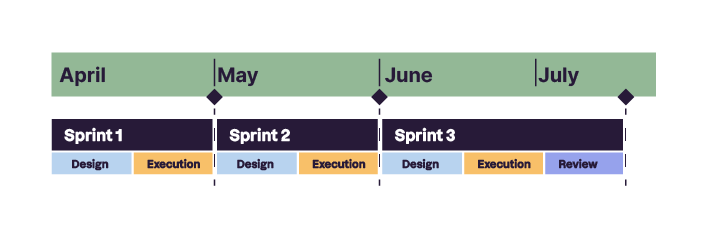
You’ll notice the example timeline includes only three phases. That’s intentional. The schedule is meant not only for the project team, but also for stakeholders and sometimes other managers—people unfamiliar with testing who won’t know the details behind every phase.
I therefore recommend grouping the phases as follows:
Phase 1: Design
Includes functional specifications analysis, writing the test strategy, and designing the test plan.
Phase 2: Execution
Includes execution of the test plan.
Phase 3: Review and Sign-off
This phase typically appears only once, at the end of the project, after all sprints. It’s rare to have a formal review after each sprint.
Plan the Different Steps
How can I estimate the time needed for each element?
The key word here is collaboration. Seek advice from project stakeholders, your peers, the development team, and the Product Owner. Agile ceremonies will help you understand the content of each sprint, supported by team experience and any estimation models (abacus) your organization may use.
You can also leverage previous projects—learning from what’s already been done helps refine your estimates.
You may even step outside your project team and speak with other teams about similar experiences.
Consider interdependencies between phases: for example, you can’t plan execution before design. What dependencies exist? Can some steps be performed in parallel?
Over to You!

Context
It’s October 11. Édouard gathers the whole team to share an update on the project.
He starts with the point you raised regarding how order details would be recorded. The specifications have been updated.
You should now refer to version 1.3 of the specifications, available here. All changes appear in blue.
Edouard also shares the following milestones:
Only one sprint is planned for this version.
Production launch is scheduled for November 21.
He asks you to provide the schedule you believe is achievable for the test campaign.
The Developers tell you they will complete development by the end of the week—October 14.
Andy reminds you he will be on vacation from October 17 to 28 inclusive.
You will be off on October 21 and October 24.
To help you, Andy reviewed the estimation charts and suggests the following effort for each phase:
Requirements analysis:
You already completed this phase from October 3 to 7.
Test Strategy → 3 days:
Started on October 10.
Test campaign → 10 days:
Test plan design → 2 days.
Execution and defect tracking → 8 days.
Campaign report → 1 day.
Instructions
Build the retroplanning based on the calendar constraints provided.
Summary
A milestone is a key step or important project event marking significant progress.
Five elements must be included when planning: requirements analysis, test strategy, test plan design, execution, and review.
Collaborate with other teams to estimate the effort required. Use your team’s knowledge and experience to plan enough time for each phase.
You’ve planned each step and you’re nearing the end of writing your Test Strategy. In the next chapter, you’ll learn how to build and communicate your recommendation.