Carry Out Omnichannel Sales

In the previous chapters, you explored many essential aspects of the Retail Sales Associate role. All of this prepares you for one of your core missions: selling.
In most industries — especially fashion and consumer retail — it’s essential to regularly introduce new products. New arrivals help attract new customers and keep loyal customers engaged. To meet expectations, a Retail Sales Associate must have a solid understanding of every product and service the company offers.
This means keeping your product knowledge up to date and staying informed about what’s new, what’s changing, and how collections evolve.
Update Your Knowledge on Products and Services
Let’s return to NexTrendish. As an omnichannel Retail Sales Associate, you guide customers across all touchpoints — in-store, on the website, or through the mobile app. Strong product knowledge helps you recommend the right items and introduce value-added services that enhance the purchase experience.
How do you stay informed about new products?
The answer depends on what tools and systems your company provides.
At NexTrendish, José, the Sales Director, ensures all team members stay aligned and informed:
Weekly newsletters: Since teams are spread across different stores and departments, José sends a company-wide email every Monday morning. It includes news updates, new product details, last week’s results, and upcoming campaigns. Newsletters are an excellent way to ensure everyone starts the week with the same information.
Supporting documents: For major launches — like the new eco-friendly collection — José also shares detailed presentations, technical sheets, and training videos. These resources help employees understand the collection thoroughly and become true product experts.
Annual product launch event: Because NexTrendish is in the fashion industry, José organizes an annual gathering where all sales teams attend a live fashion show presenting the new collections. Employees get to see, touch, and discuss the products before they hit the stores, while networking with designers and material specialists. These events are also great moments of team bonding.
What additional methods would you recommend to José?
For my part, I would add printed brochures and catalogs that stores and departments can keep on hand. These make it easier to access product information directly on the sales floor — and even share with customers who want to explore items in more detail.
Are we ready to sell new products now?
Almost! Before becoming fully confident and credible with customers, there’s one more step: understanding the competition.
Knowing your products isn’t enough — you must also be aware of what competing brands offer. This helps strengthen your sales pitch, build customer trust, and avoid being caught off guard by questions during the sale.
Digital tools make this extremely simple:
Browse competitor websites, social media, and online ads.
Analyze customer reviews to understand strengths and weaknesses.
Visit competitor stores when possible to observe products firsthand.
This product and competitor knowledge will help you confidently guide customers and deliver exceptional experiences.
Adapt Your Communication When Initiating Contact
Your salesperson toolkit already includes several communication frameworks. Earlier in the course, you learned SBAM (adapted as the Customer Courtesy Principles), CROC, and AIDA. These help structure your approach and ensure a smooth, professional interaction.
Always remember the basics of courtesy: maintain a professional, friendly tone, follow through on customer expectations, and respect their preferred contact method. For example, if a customer asks to be called between 4 p.m. and 6 p.m., do not call outside that window or use a different channel.
The rule focuses on four elements during the first moments of customer interaction:
Element | Description | Tips |
The first 20 seconds | Capture attention and set a positive tone immediately. | Greet warmly, smile, and show positive energy. |
The first 20 words | Your opening words should be polite, clear, and helpful. | Use simple, friendly phrases and show you’re here to assist. |
The first 20 inches of the face | Your facial expression communicates approachability. | Maintain a natural smile and warm eye contact. |
The first 20 gestures | Your body language should be open and reassuring. | Stand comfortably, avoid crossed arms, and stay approachable. |
At NexTrendish, the 4 x 20 Rule is part of the in-store experience. To help you practice, José asks you and Robin to perform a short role-play:
José walks into the store. Robin turns toward him with a warm smile and open posture.
Robin: “Hello and welcome to NexTrendish! How can I help you today?”
Robin approaches at a comfortable distance, staying available but not intrusive. José signals he prefers to browse on his own.
José: “Hi, thank you. I’m just looking around for now.”
Robin: “Of course, take your time! Feel free to explore our collections. I’m right here if you need any help or product information.”
Robin returns to his tasks, maintaining a friendly expression. José gives him an appreciative nod before browsing.
This scenario shows Robin applying the 4 x 20 Rule perfectly, creating a welcoming environment while respecting the customer’s need for space.
Every customer is unique, which means every interaction requires adaptability. Techniques help structure the approach, but personalization is what makes the difference.
To personalize your approach, you should study the customer profile. Available data varies depending on whether the interaction is outbound or inbound:
Outbound contact (you initiate contact): You have more time to prepare and review the customer profile.
Inbound contact (the customer initiates): You must quickly assess the situation using observation, listening, and clarifying questions.
Here are some key profiling criteria:
Criterion | Description | Example |
Demographic data | Age, gender, location, family situation | A customer without children will have different needs than a parent with two kids. |
Buying behavior | Purchase frequency, average basket, product categories | A frequent customer with a high average spend may expect premium options. |
Communication preferences | Preferred channels and tone | A customer who prefers email expects structured and written follow-up. |
Interests & motivations | Hobbies, passions, reasons for purchase | A customer passionate about eco-friendly fashion is more receptive to sustainable products. |
Brand relationship | Loyalty, past satisfaction, complaints | A long-time customer appreciates exclusive perks. |
Lifestyle & personality | Eco-conscious, price-focused, analytical, spontaneous | An eco-conscious customer will prioritize durability and materials. |
Ask Questions to Identify Specific Customer Needs
Can I rely solely on what I observe?
Observation is important, but conversation is essential. Selling involves investigation — uncovering needs, expectations, motivations, and constraints. Customers may not always express these clearly, or even be fully aware of them.
This is where your role as an advisor becomes crucial. If you understand your customer, the sale becomes easier and often feels natural.
Sales training often describes seven steps in the sales process:
Step | Description | Actions | Example Methods |
1. First contact | Initiate the interaction. | Greet the customer or contact them via email/phone. | Courtesy Principles, CROC, 4x20 |
2. Needs discovery | Understand expectations. | Ask open questions. | Discovery plan, questioning techniques |
3. Product presentation | Show how the product fits their needs. | Highlight benefits tied to needs. | CAP/CAB |
4. Objection handling | Clarify concerns. | Reassure, provide proof. | Objection-handling techniques |
5. Negotiation | Discuss conditions when needed. | Clarify expectations, propose solutions. | Price presentation |
6. Closing | Finalize the purchase. | Review choices, confirm agreement. | Buying signals |
7. Goodbye | Leave a positive final impression. | Thank, recap, invite back. | 4R Rule |
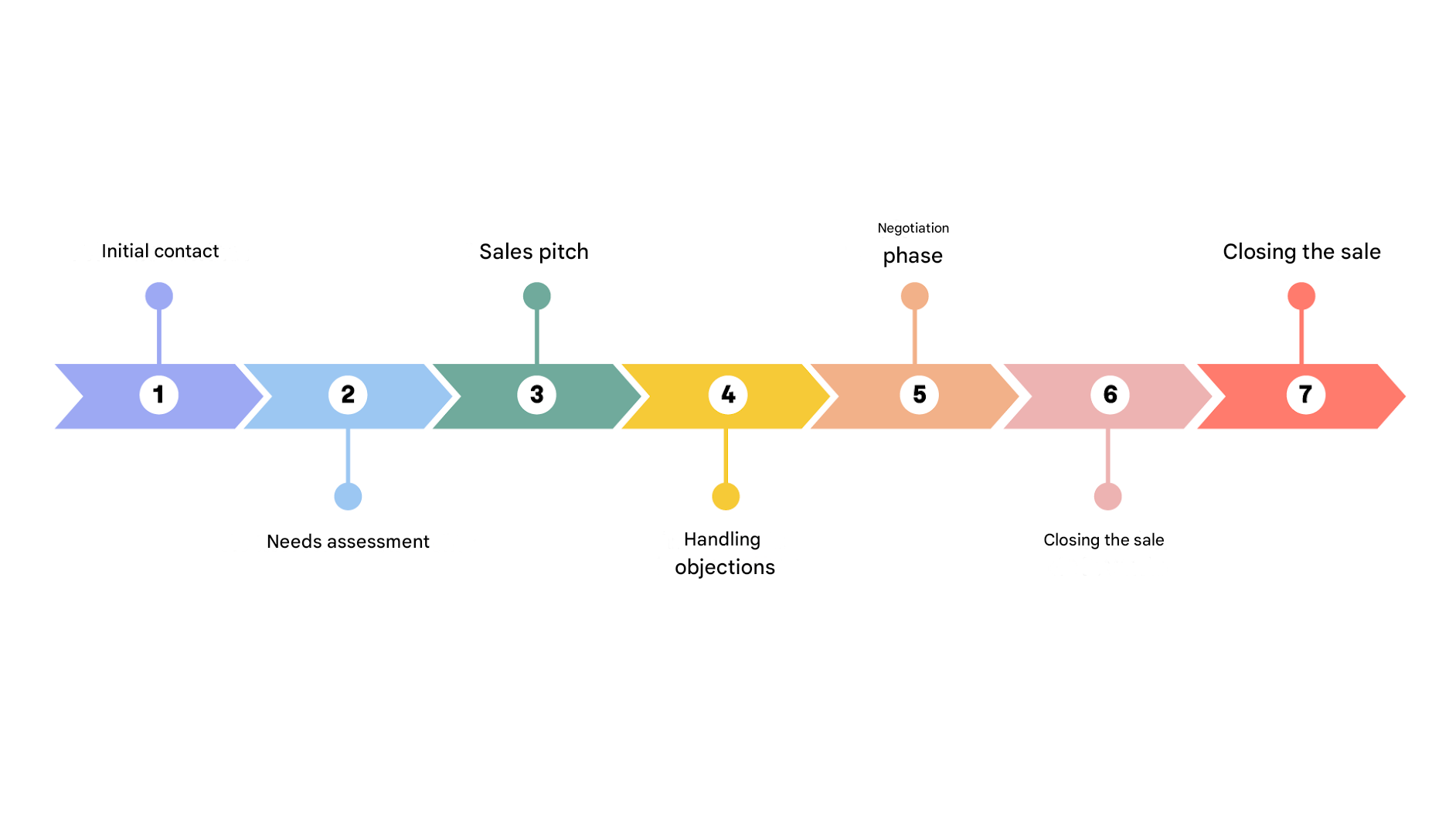
Let’s focus now on Step 2: Needs discovery, illustrated by this role-play between José and Robin:
José: “Excuse me, do you have sleeveless jackets?”
Robin: “Absolutely. We have several models. To recommend the best one, could you tell me a bit about how you’ll use it? Is it for a specific occasion or everyday wear?”
José: “Mostly for cooler days — I’ll be hiking a lot this fall.”
Robin: “Got it — something lightweight that still keeps you warm. Any preferences for style or color?”
José: “Neutral colors — black or gray — and nothing too bulky.”
Robin: “Perfect. One last question: do you have a budget in mind? Some models vary depending on technical features.”
José: “I’d like to stay under €150, but if it’s a great piece, I can stretch a bit.”
Robin: “Understood. I have exactly what you’re looking for — and we’re offering 10% off when purchasing two items from this collection. Let me show you a few options.”
Your analysis:
Usage & context: Robin clarifies when and how the vest will be used.
Preferences: He clarifies style and color preferences.
Budget: He approaches the question tactfully and highlights promotions.
Close the Sale and Suggest Add-On Products
Loyalty and sales performance grow when the associate doesn’t stop at the main product, but looks for additional items that genuinely enhance the customer experience.
During an observation session, you watch Agathe assist a first-time customer. She recommends a pair of sustainable pants — and once the customer agrees, she naturally proposes a matching belt.
Agathe: “Great choice with those pants — they look fantastic on you! To complete your outfit, have you considered a belt? We have one in the same eco-friendly collection that pairs perfectly with this style. And right now, you get 10% off when purchasing two items from this line.”
This is a perfect example of relevant, customer-focused upselling. Since the customer previously mentioned needing a new belt, the suggestion is not pushy — it's helpful.
When done well, upselling benefits everyone: the customer leaves with a more complete solution, and the business increases sales.
Before checkout, always confirm whether the customer is in the CRM and offer loyalty program enrollment if appropriate.
Handling Payment
Depending on the channel, different payment options may be available:
Cash (in-store only)
Credit/debit card (payment terminal in-store, secure payment online)
Online platforms (PayPal, etc.)
Check (store only, depending on country)
Bank transfer (mostly online)
Store credit, gift cards, rewards points
Financing or installment plans
Use the 4R Rule When Ending the Sale
Reassure: Provide confidence and clarity.
Thank: Show appreciation.
Accompany: Guide the customer through next steps.
Invite Back: Encourage future visits.
Here’s how Agathe applies the 4R Rule:
Agathe: “You made an excellent choice — these pieces will last you a long time. (Reassure)”
Client: “Thanks, I’m excited to try them on.”
Agathe: “Thank you again for your purchase! (Thank) Let me walk you to the front. (Accompany)”
At the exit:
Agathe: “Have a great day! Feel free to visit us again — and follow our newest arrivals online. (Invite Back)”
Over to you!

Context
You’re back at the NexTrendish customer service center with Robin. Today’s mission: respond to customers contacting you through the mobile app.
While you step away briefly, Robin handles incoming messages. When you return, he proudly announces:
“I made a sale! Check out this conversation — the customer needed advice for a special event, and I sold him a suit!”
But a closer look shows that Robin didn’t actually complete the sale.
Analyze the Conversation
Here’s the exchange:
Client: Hello! I’m looking for an outfit for a special event, but I’m not sure what to choose. Can you help?
Robin: Hi! Sure. What’s the event?
Client: It’s an evening wedding. I want something elegant but not too formal. I was thinking of a suit, but I’m unsure about colors.
Robin: Okay. Black is usually good.
Client: I prefer navy, but I’m also considering gray. Any accessory suggestions?
Robin: Accessories depend on what you like. Maybe a tie? Or a bow tie — it’s trendy.
Client: Good idea. I’ll go with navy then. Do you have shoes that match?
Robin: Yes, there are shoes. Black or brown both work.
Client: I prefer something more relaxed — brown then.
Robin: Okay, brown. You don’t need shoe care products, right?
Client: Not sure — are they useful?
Robin: Maybe. I don’t use them myself, so I don't know.
Client: Alright, I’ll think about it and come back later to buy. Thanks!
Robin: No problem. Have a good day!
Identify the improvement points you would share with Robin.
Summary
Retail Sales Associates must master product knowledge and competitive insights.
Strong communication inspires customer trust.
Understanding the customer is essential — listening and questioning are key to effective selling.
Relevant add-on sales create value for both the customer and the business.
Customer relationships are cyclical — loyalty is built at every step, not just during a purchase.
Congratulations — you’ve completed the course on discovering the Retail Sales profession! I hope you enjoyed exploring this versatile, evolving field. To validate your learning, take the final quiz.