Position Yourself in the Project Lifecycle
Position Yourself in a Development Project
Where and when do I step in?
Excellent question!
Depending on the project management model, the tester won’t step in at the same moment or carry out the same activities.
Let’s look at where the tester fits within the three most common development models: the waterfall model, the V-cycle model, and the agile methodology.
As a reminder, the waterfall model and the V-cycle model are sequential models, whereas the agile methodology is incremental and iterative.
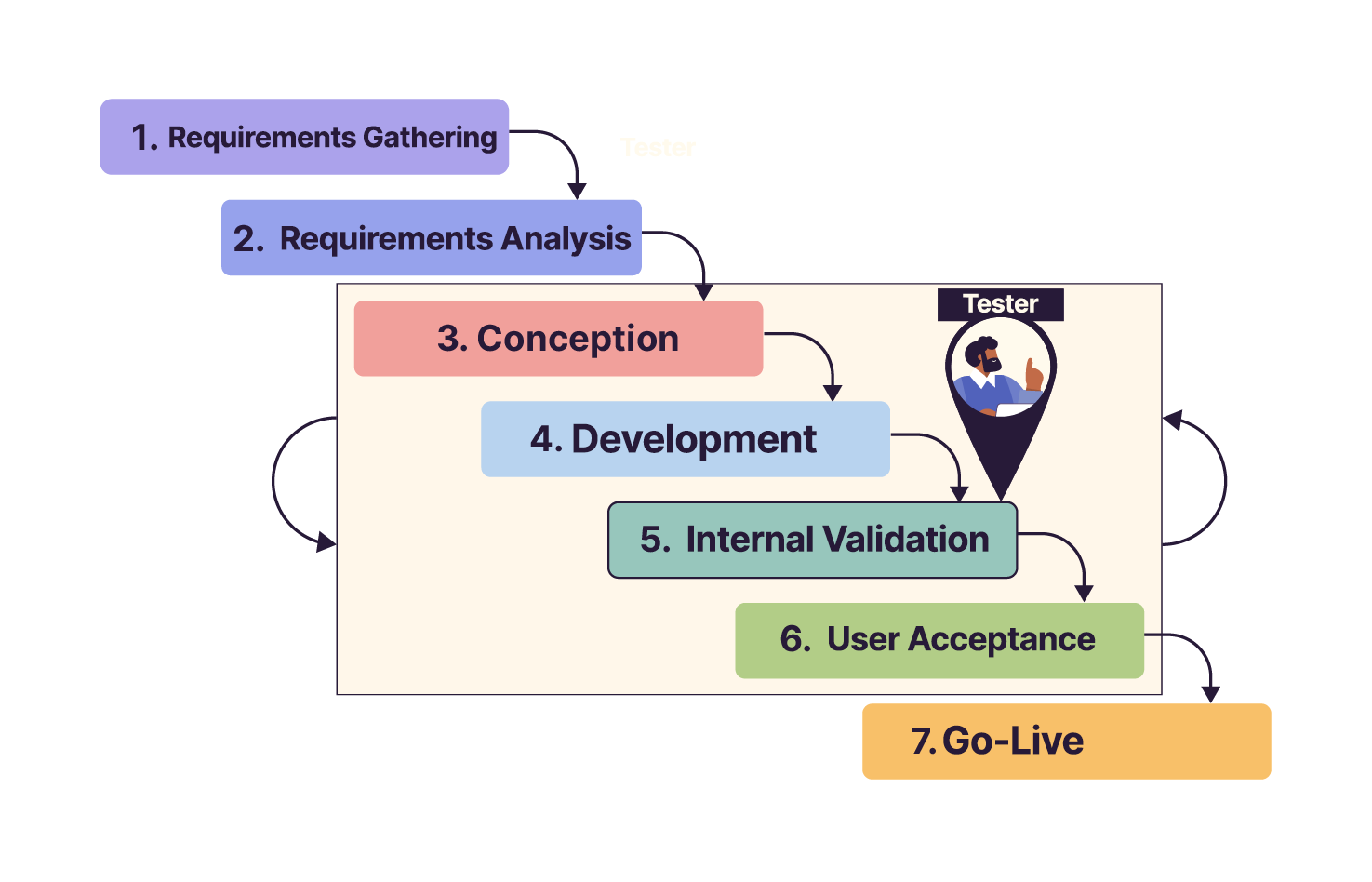
Let’s start with the waterfall model, which includes the following phases:
Requirements gathering
Requirements analysis
Conception
Development
Internal validation
User acceptance
Go-live
Each phase begins only when the previous one is complete, and the tester steps in only during the validation phase. This means that if defects are found during validation, development must resume, and the tester must wait until implementation is complete again before continuing with validation. And if a defect reveals a design issue, the cycle must go back another phase, slowing the entire development process. This is one of the common criticisms of this model.
Now let’s move on to the V-cycle model:
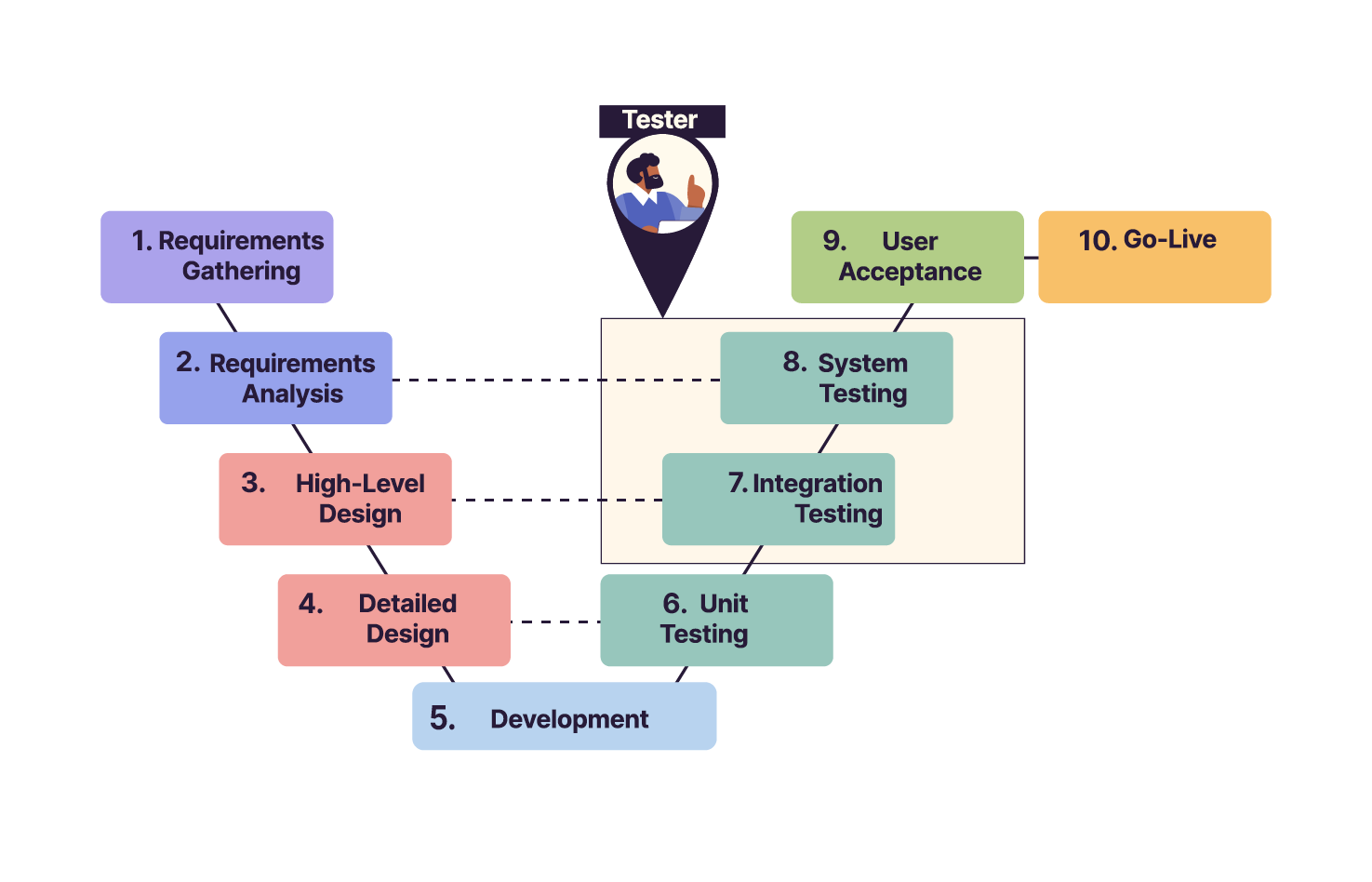
The first series of steps, the downstream flow, details the product until it is built:
Requirements gathering
Requirements analysis
High-level design: defining the functional and technical specifications while considering constraints and requirements
Detailed design: creating the plans, diagrams, and models needed to meet these specifications
Development
The second series of steps, the upstream flow, validates the product until its acceptance by the user:
Unit testing
Integration testing
System testing
User acceptance
Go-live
An important characteristic of the V-cycle model is that for each production phase, a test is designed. For example, system tests are designed during the analysis phase:
this avoids falling back into the issues seen in the waterfall model;
it verifies the alignment of upstream (top-down) phases through appropriate testing.
Now let’s look at the incremental and iterative model used in the agile methodology:
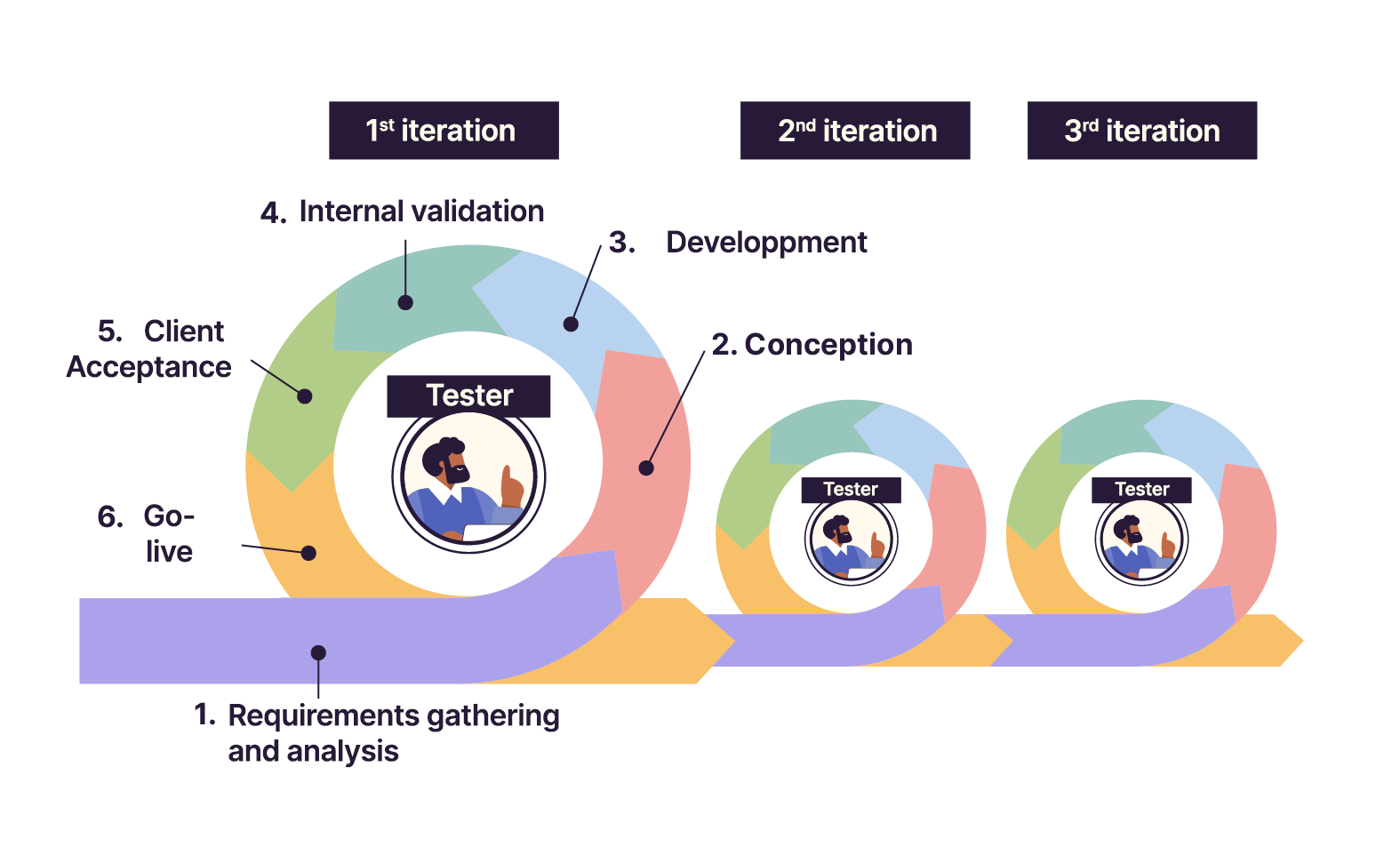
It works through successive iteration loops (called sprints).
The tester is involved at every step of the loop:
Requirements gathering: defining acceptance criteria
Conception: defining system tests
Development: understanding how APIs and the product work as a whole, and preparing integration tests
Internal validation after each delivery,
Go-live
In this sense, the model resembles the V-cycle model.
Understand Iteration in Software Development
Let’s take a closer look at how iterative models work using the agile methodology.
The agile methodology emphasizes collaboration, flexibility, and speed. It contrasts with the traditional waterfall method, which is more rigid and less adaptable.
In the agile methodology, teams work collaboratively and iteratively, frequently adapting to changing customer needs. Instead of planning the entire development upfront, teams work in short cycles (“sprints”), developing parts of the software, testing them, and delivering them to the customer for feedback.
Constant communication between team members and the customer is essential. Quick daily meetings, called daily stand-ups, keep the team aligned on progress and obstacles. Longer meetings, called Sprint Retrospectives, analyze what went well and what can be improved in the next sprint.
The agile methodology also emphasizes quality and delivering value to the customer. Frequent releases allow customers to provide rapid feedback on new features.
In short, the agile methodology is a development approach based on collaboration, flexibility, and speed, working closely with the customer to deliver high-quality software that meets their needs.
Over to You!

Reflect on your place in a project team by identifying which development model suits you best.
Instructions:
Think about the development models you know (V-cycle model, waterfall, agile methodology, etc.).
Identify their advantages and disadvantages.
Reflect on your past experience with these models—what you liked or disliked.
Consider your working style and how you prefer to operate in a team.
From this reflection, choose the model that best fits your working style and explain why.
Summary
You now know where and when to position yourself as a tester depending on the development model used.
You understand the differences between the waterfall, V-cycle model, and agile models.
You’ve had an introduction to iterative and incremental methods through agility.
You now have a strong grasp of software testing as a whole. I invite you to check your knowledge in the quiz that follows, and then we’ll move on to a more hands-on approach to testing.